
Major and minor: one note makes the difference
A triad can change character when just one note moves a semitone. The third is a good place to start understanding chords.

Three notes around a root
A standard major triad consists of a root, major third and perfect fifth. The formula is 1–3–5. C major therefore contains C, E and G.
A minor triad keeps the root and fifth but lowers the third by a semitone. The formula becomes 1–♭3–5. C minor contains C, E♭ and G.
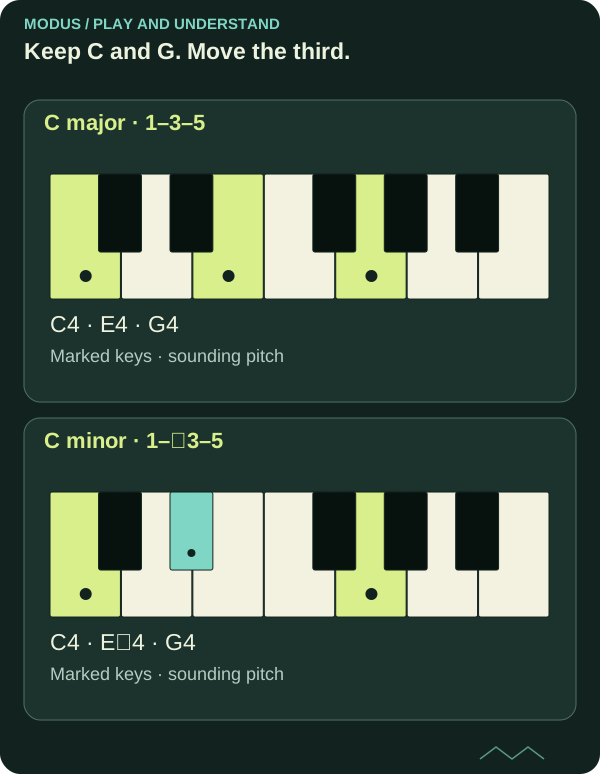
Read the diagram as text
- C major · 1–3–5: C4 → E4 → G4
- C minor · 1–♭3–5: C4 → E♭4 → G4
Major does not always mean happy
Major and minor describe a chord’s interval structure. They do not assign a fixed emotion to the music. Tempo, rhythm, register, dynamics and surrounding chords all affect the expression.
A slow major chord may feel vulnerable, and a rhythmic minor chord may feel energetic. Use your ear to explore the difference without forcing it into one mood.
The same chord in different registers
C–E–G, E–G–C and G–C–E contain the same three chord tones. When a chord tone other than the root is lowest, you have an inversion.
On guitar, some notes may be doubled. An open C shape can contain several Cs or Es and still be a C major chord. A chord’s identity depends on the notes and context, not just the number of strings you play.
Find the third in your own chord shape
Play E minor and locate at least one G in the shape. G is the minor third above E. Raise it to G♯ while keeping E and B, and you have the notes of E major. On piano, hold E and B and alternate slowly between G and G♯.
If G occurs in more than one place in the guitar shape, account for every occurrence when changing the chord. Raising only one of two Gs produces both a minor and a major third, not an ordinary E major triad.
FROM READING TO PLAYING
Try it yourself.
Choose C major and C minor in the theory room. Keep C and G and move only E to E♭. Then listen to the same difference in E major and E minor.
Build and listen to chordsCHECK YOUR UNDERSTANDING
What do you remember?
Three questions about what you have read. Get all three right to complete the quiz. Try as many times as you like.
Completion is saved in this browser and shared between Norwegian and English.
You answered all three questions correctly. Take the idea to your instrument.
Back to the article library ↗︎