
Harmonic minor and Phrygian dominant
A raised seventh gives minor tonality a clear leading note. The same notes can take on a very different character with the fifth degree as their centre.

The raised seventh in minor
A natural minor contains A, B, C, D, E, F and G. Raise G to G♯ and you get A harmonic minor: A–B–C–D–E–F–G♯.
The formula is 1–2–♭3–4–5–♭6–7. G♯ is a semitone below A and can act as a leading note. It also lets the chord on the fifth degree have a major third: E–G♯–B, or E7 when D is added.
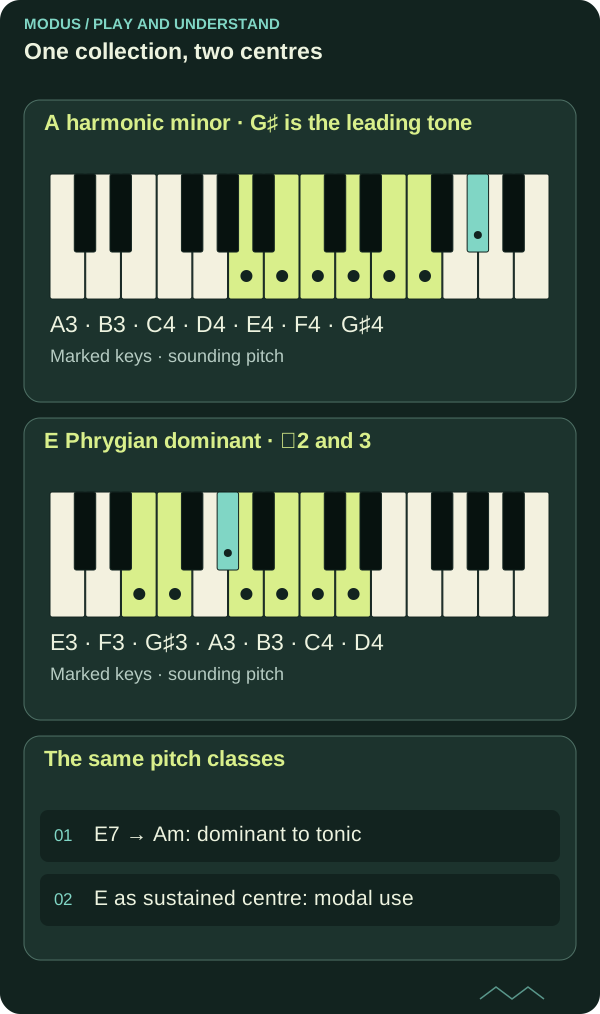
Read the diagram as text
- A harmonic minor · G♯ is the leading tone: A3 → B3 → C4 → D4 → E4 → F4 → G♯4
- E Phrygian dominant · ♭2 and 3: E3 → F3 → G♯3 → A3 → B3 → C4 → D4
- The same pitch classes: E7 → Am: dominant to tonic; E as sustained centre: modal use
The fifth mode finds a new centre
With E as the centre, the same notes give E Phrygian dominant: E–F–G♯–A–B–C–D. The formula becomes 1–♭2–3–4–5–♭6–♭7.
The minor second F sits close to E, while G♯ provides a major third. This combination of ♭2 and 3 distinguishes the sound from ordinary Phrygian, which has a minor third.
Distinguish function from modal colour
E7 can act as the dominant of A minor. E Phrygian dominant can then offer a scale colour over the dominant before the music returns home to A.
If E is instead sustained as the musical centre, you can explore the same notes modally. The harmonic experience is not automatically the same, even though the notes match.
F to G♯ is an augmented second: three semitones. Use the leap deliberately and also try phrases that connect it through the root E or the fourth A.
Limit the exploration to two differences
Start with A natural minor versus A harmonic minor, changing only G to G♯. Then compare E Phrygian with E Phrygian dominant, changing G to G♯ while keeping E as the centre. In the latter comparison, the third changes from minor to major.
Use one short phrase at a time and explain which note changes. This focused experiment shows the relationship without requiring you to learn every mode of harmonic minor at once.
FROM READING TO PLAYING
Try it yourself.
Play E–F–E and then E–G♯–E over an E drone. Combine the two ideas. Compare with ordinary E Phrygian by replacing G♯ with G.
Play over E Phrygian dominantCHECK YOUR UNDERSTANDING
What do you remember?
Three questions about what you have read. Get all three right to complete the quiz. Try as many times as you like.
Completion is saved in this browser and shared between Norwegian and English.
You answered all three questions correctly. Take the idea to your instrument.
Back to the article library ↗︎