
Diatonic modes: one note system, seven musical perspectives
Seven modes do not mean seven separate maps. Start with one collection of notes, learn to hear where the music feels at home, and use characteristic tones to create a distinctive sound.
WHAT YOU WILL LEARN
Diatonic modes: one note system, seven musical perspectives
- Explain how the same seven notes can form seven different modes.
- Distinguish relative modes from parallel comparisons.
- Hear and use characteristic tones over a clear tonal centre.
- Apply the idea to guitar, piano, improvisation and composition.
Before you start
Know the major scale and major/minor thirds, fourths, fifths, sixths and sevenths. You do not need to memorise seven guitar boxes.

One collection of notes, seven possible homes
A scale map tells us which notes are available. It does not by itself tell us which note feels like home. That depends on bass, harmony, melodic resting points, rhythmic emphasis and repetition.
Take C major’s seven notes: C–D–E–F–G–A–B. Establish C as centre for C Ionian. With D as the actual tonal centre, the same material can sound like D Dorian; with E, like E Phrygian. No note has changed. The reference point against which we hear the notes has changed.
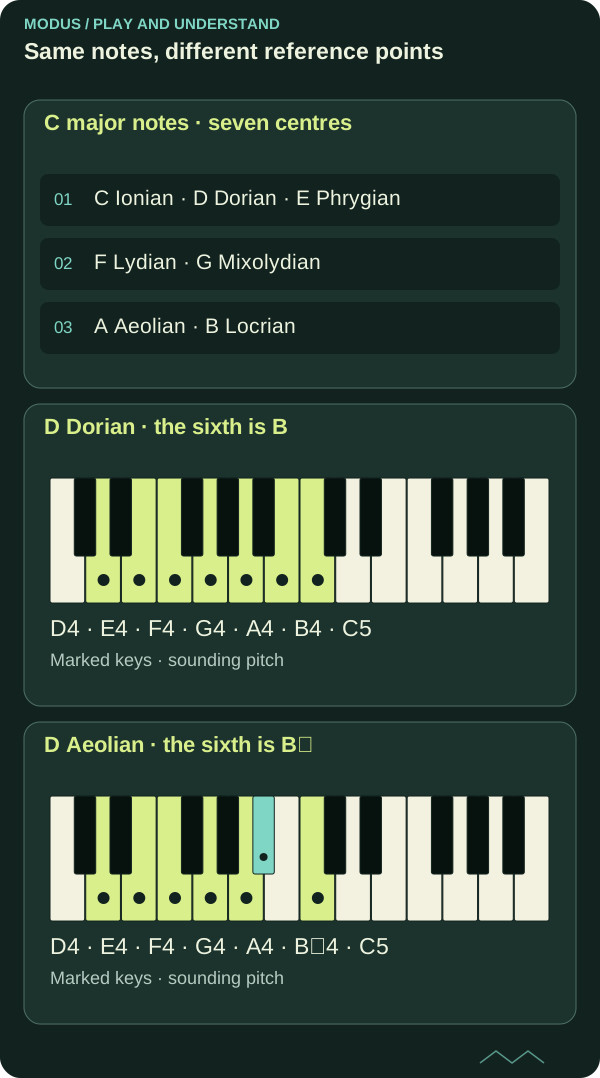
Read the diagram as text
- C major notes · seven centres: C Ionian · D Dorian · E Phrygian; F Lydian · G Mixolydian; A Aeolian · B Locrian
- D Dorian · the sixth is B: D4 → E4 → F4 → G4 → A4 → B4 → C5
- D Aeolian · the sixth is B♭: D4 → E4 → F4 → G4 → A4 → B♭4 → C5
The seven modes in one map
Here is the family derived from C major. The final column describes characteristic degrees relative to major for major-type modes and natural minor for minor-type modes. Locrian is distinctive because of its diminished fifth.
| Mode | Centre using C-major notes | Interval formula | Characteristic |
|---|---|---|---|
| Ionian | C | 1–2–3–4–5–6–7 | Major, major seventh |
| Dorian | D | 1–2–♭3–4–5–6–♭7 | Minor with major sixth (6) |
| Phrygian | E | 1–♭2–♭3–4–5–♭6–♭7 | Minor with minor second (♭2) |
| Lydian | F | 1–2–3–♯4–5–6–7 | Major with augmented fourth (♯4) |
| Mixolydian | G | 1–2–3–4–5–6–♭7 | Major with minor seventh (♭7) |
| Aeolian | A | 1–2–♭3–4–5–♭6–♭7 | Natural minor, minor sixth |
| Locrian | B | 1–♭2–♭3–4–♭5–♭6–♭7 | Diminished fifth (♭5), unstable tonic |
Ionian is the ordinary major scale and Aeolian is natural minor. Locrian is theoretically important but harder to establish as a stable centre because its tonic triad is diminished. Hearing modal differences is more useful than ranking modes by fixed mood words.
Relative and parallel modes answer different questions
Relative modes share the same notes but have different centres. C Ionian, D Dorian and E Phrygian are relative in our example: one connected view of the material.
Parallel modes keep the same centre but change the intervals. D Dorian has D–E–F–G–A–B–C; D Aeolian has D–E–F–G–A–B♭–C. The difference is B versus B♭: major versus minor sixth.
Do not confuse these perspectives. Relative thinking helps locate notes on an instrument. Parallel thinking isolates what gives a mode its character. Both help, but they solve different problems.
Learn to hear the characteristic tone
Take D Dorian. Play a quiet D bass or use Dm as the starting chord. Then play a short melody such as D–F–A–B–A–F–D. Notice B, the major sixth above D.
Repeat exactly the same phrase, changing only B to B♭. The collection now points towards D Aeolian. Keep rhythm and the remaining notes unchanged so you know you are investigating the sixth.
Harmony can help: use Dm–G, with D clearly home, for Dorian; G major contains B. Compare Dm–Gm for Aeolian; Gm contains B♭. These are examples, not guarantees. If you play them as a functional cadence towards another centre, the perceived tonality may change.
The fretboard: one connected map, not seven new boxes
You do not need a new pattern at every chord. Start with one familiar diatonic map across the fretboard. It shows note locations; their meaning depends on the centre and surrounding harmony.
The G-major collection G–A–B–C–D–E–F♯ can support G Ionian, A Dorian, B Phrygian, C Lydian, D Mixolydian, E Aeolian and F♯ Locrian. On the low E string, F♯ is at fret 2 and G at fret 3. They are neighbours in one map. Moving from F♯ to G does not by itself change the music from Locrian to Ionian.
Play a G drone under the phrase and hear G as home. Then place an A drone under the same notes and try to make A feel settled. Only an actual change of centre gives a meaningful modal change. The same applies on piano: bass and phrase endings do the work while the notes stay the same.
Seven positions can help navigation. Connect them into one system rather than seven unrelated maps.
Do not change mode automatically at every chord
In a diatonic progression such as Em–C–G–D, G-major/E-natural-minor notes can work throughout. That does not necessarily mean four separate tonal worlds labelled E Aeolian → C Lydian → G Ionian → D Mixolydian.
Chord–scale labels describe intervals above a chord root. Perceived modality concerns the music’s centre. A progression may retain an overall centre while its chords change. In improvisation, following chord tones, voice-leading tendencies and melodic targets can be more useful than changing the whole map.
Ask at each change: Which note will I land on, and why? Keep the map and change the phrase. New scales become necessary when harmony or expressive intent actually calls for different notes.
From theory to your own music
Hold a D bass and write a four-bar Dorian melody in which B is clear but does not dominate. Write another ending using B♭, pointing towards D Aeolian. Changing one note changes the possibilities for harmony and melodic tension.
Compare C Lydian with C Ionian: F♯ versus F. Compare E Phrygian with E Aeolian: F versus F♯. Keep the root and change one characteristic tone at a time.
Modern rock, fusion and progressive metal can use this to choose melodic colours deliberately, even over a simple pedal bass. No mode guarantees one expression: phrasing, rhythm, timbre and harmony still matter.
The method: hear, predict, play, explain, change
Hear: Play the phrase with D as centre. Predict: Sing how the melody will change when B becomes B♭. Play: Check on guitar or piano. Explain: Describe how major and minor sixths produce different interval structures above D. Change: Use the difference for a new ending or chord colour.
The aim is more than reproducing a scale: it is to hear, understand and use the difference in your music.
References: Open Music Theory: Diatonic Modes and Berklee Online: Music Modes. MODUS examples and the practice sequence are teaching applications, not reproductions of the sources. Here “church modes” refers to the modern seven-mode diatonic system; historical church modality also used other rules, finals and authentic/plagal forms.
FROM READING TO PLAYING
Try it yourself.
Keep D as centre and play D–F–A–B–A–F–D, singing B before playing. Change only B to B♭, listen and explain. Then play two bars of Dm–G and two of Dm–Gm. Which modal colour do you hear, and what creates it?
- Hear: Play a D drone and sing major and minor sixths without looking at the instrument.
- Predict and play: Repeat one phrase with B and B♭, keeping rhythm and register unchanged.
- Explain and change: Describe the interval difference and write a modal phrase with two parts.
CHECK YOUR UNDERSTANDING
What do you remember?
Three questions about what you have read. Get all three right to complete the quiz. Try as many times as you like.
Completion is saved in this browser and shared between Norwegian and English.
You answered all three questions correctly. Take the idea to your instrument.
Back to the article library ↗︎RECOMMENDED NEXT STEP
Dorian and Aeolian: same tonic, new colour
Continue with a controlled parallel comparison using the same centre and just one altered degree.
Dorian and Aeolian: same tonic, new colour ↗︎