
Roman numerals: the chords behind the numbers
Roman numerals describe relationships rather than fixed chord names. Learn the numbers first, then use them to understand chords in a key, transpose progressions and hear where the music is heading, wherever you play.
WHAT YOU WILL LEARN
Roman numerals: the chords behind the numbers
- Read Roman numerals I to X and explain why IV means four.
- Identify a chord’s scale degree and distinguish major, minor and diminished.
- Turn a Roman-numeral progression into chords in different keys.
- Distinguish Roman numerals, chord names and inversions.
Before you start
You should know what a key, a major scale and a major or minor triad are. Start with the articles on intervals and chords if needed.

First: a short introduction to Roman numerals
Roman numerals are an older number system also used in music theory. Before analysing any chords, learn three signs: I means 1, V means 5 and X means 10. Combine them to write other numbers.
| Roman numeral | Number | How to remember it |
|---|---|---|
| I | 1 | One unit |
| II | 2 | Two units |
| III | 3 | Three units |
| IV | 4 | One before five: 5 − 1 |
| V | 5 | Five |
| VI | 6 | Five plus one |
| VII | 7 | Five plus two |
| VIII | 8 | Five plus three |
| IX | 9 | One before ten: 10 − 1 |
| X | 10 | Ten |
A smaller sign before a larger one is subtracted: IV = 4 and IX = 9. After it, the smaller sign is added: VI = 6. In ordinary functional harmony we mainly use I to VII, because we build chords on the seven scale degrees.
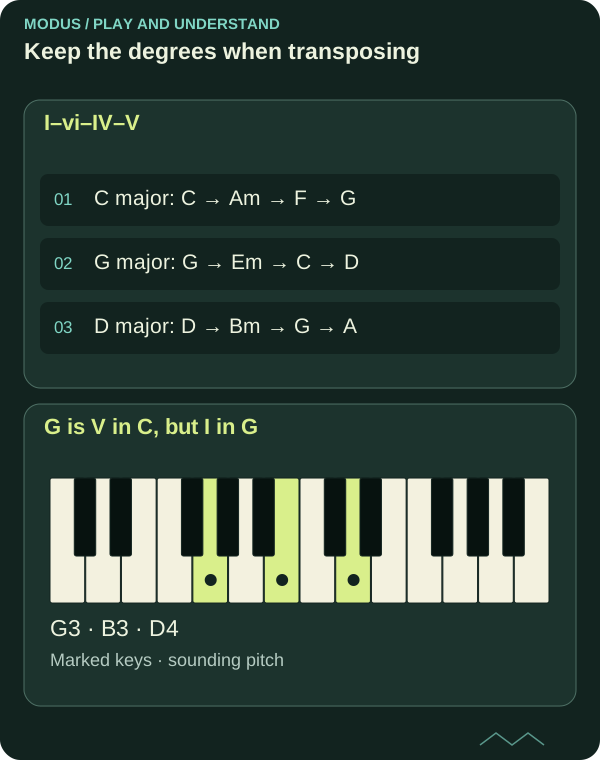
Read the diagram as text
- I–vi–IV–V: C major: C → Am → F → G; G major: G → Em → C → D; D major: D → Bm → G → A
- G is V in C, but I in G: G3 → B3 → D4
The chord name tells you what; the numeral tells you where
Take C major: C–D–E–F–G–A–B. Build a triad on each degree by taking alternate notes. C–E–G gives C major, D–F–A gives D minor, and so on.
A chord name such as G identifies the notes forming the chord. A Roman numeral such as V locates the chord’s root within the key being analysed. G is V in C major but I in G major. That is why the system is useful.
| Degree in C major | Chord | Roman numeral |
|---|---|---|
| 1 · C | C | I |
| 2 · D | Dm | ii |
| 3 · E | Em | iii |
| 4 · F | F | IV |
| 5 · G | G | V |
| 6 · A | Am | vi |
| 7 · B | Bdim (B–D–F) | vii° |
Uppercase and lowercase matter
We use an important convention: uppercase numerals indicate major triads (I, IV, V), while lowercase numerals indicate minor triads (ii, iii, vi). A small circle, °, means diminished: vii°. A plus sign, +, indicates an augmented triad, for example III+.
Thus II and ii are different. Both have their root on degree two, but II is major and ii is minor. In C major, Dm is the diatonic ii. D major may appear as II, but contains F♯ and lies outside the key’s usual diatonic triads. We would often investigate whether it has a particular harmonic function.
Move the progression; keep the relationship
Take C–Am–F–G. In C major this is I–vi–IV–V. Now move it to G major, whose notes are G–A–B–C–D–E–F♯. The same degrees give G–Em–C–D. The chord names change, but the numerals remain.
| Key | I | vi | IV | V |
|---|---|---|---|---|
| C major | C | Am | F | G |
| G major | G | Em | C | D |
| D major | D | Bm | G | A |
This is transposition in practice. Instead of memorising a song as disconnected chord names, understand the relationships. On guitar choose new shapes; on piano find the new chord tones. Roman numerals provide a shared language.
What do i–iv–V and ii–V–I mean?
Use the numerals to understand two common progressions. In C major, ii–V–I = Dm–G–C, or Dm7–G7–Cmaj7 with sevenths. The roots are on degrees two, five and one. The final chord is home in this key. The numerals describe chord relationships; they do not automatically determine an improvisation mode.
In A minor, i–iv–V = Am–Dm–E. Notice that E is major. A natural minor contains G and would give Em as diatonic v. Raising G to G♯ gives E major a stronger dominant pull. That is why V is common in minor-key harmony. Analyse the actual chord and its musical context.
Play C–F–G–C slowly and notice G’s pull towards C. Then play Dm–G–C. You reach the same home from a different starting point.
Sevenths, inversions and common misreadings
Numerals can show more detail. V7 is a seventh chord on degree five, such as G7 in C major. The 7 describes the chord’s added seventh, not a move to scale degree seven. vii° is a diminished triad on degree seven; the circle is not a zero.
In traditional figured-bass and Roman-numeral analysis, I6 usually means a first-inversion tonic triad, such as C/E. It does not automatically mean a C6 chord with added A. I6/4 means second inversion, C/G. Some modern pop and jazz charts use other systems; check the notation being used.
Similarly, I–IV–V does not tell you to play Ionian, Lydian and Mixolydian in turn. It identifies chords relative to a key. Mode labels and Roman numerals answer different musical questions.
Our method: hear → predict → play → explain → change
Hear: Play I–IV–V–I in C major and listen for the return home. Predict: Name I, IV and V in G major before playing. Play: Check on guitar or piano. Explain: Why is D major V in G major but II in C major? Change: Transpose I–vi–IV–V into another key and write a short melody landing on a chord tone at each change.
This takes you from knowing the signs to using harmony. Roman numerals are not music by themselves; they reveal patterns in what you hear and play.
References: Open Music Theory – Roman Numerals and musictheory.net – Roman Numeral Analysis: Triads. The explanations and practice sequence are adapted for MODUS.
FROM READING TO PLAYING
Try it yourself.
Analyse C–Am–F–G in C major as Roman numerals. Transpose it to G major without consulting the table. Check on guitar or piano and explain why Em is vi in G major.
- Read: Say I, II, III, IV, V, VI, VII and translate them into 1–7.
- Build: Find C, Dm, Em, F, G, Am and Bdim on the instrument and label each correctly.
- Move: Play I–vi–IV–V in C and G major. Listen and explain what stays the same.
CHECK YOUR UNDERSTANDING
What do you remember?
Three questions about what you have read. Get all three right to complete the quiz. Try as many times as you like.
Completion is saved in this browser and shared between Norwegian and English.
You answered all three questions correctly. Take the idea to your instrument.
Back to the article library ↗︎RELATED READING
ii–V–I: why chords want to go home
Use Roman numerals to hear and explain a functional cadence in different keys.
ii–V–I: why chords want to go home ↗︎