
Seventh chords: more colour, the same foundation
Adding a seventh to a triad brings a new shade of colour. Chord symbols become easier to read when you distinguish the quality of the third from that of the seventh.

Build on the triad
A seventh chord has four different notes in its basic form: root, third, fifth and seventh. Notes can be doubled or moved to other octaves without changing the chord type.
| Chord | Formula | Notes |
|---|---|---|
| Cmaj7 | 1–3–5–7 | C–E–G–B |
| C7 | 1–3–5–♭7 | C–E–G–B♭ |
| Cm7 | 1–♭3–5–♭7 | C–E♭–G–B♭ |
| Cm(maj7) | 1–♭3–5–7 | C–E♭–G–B |
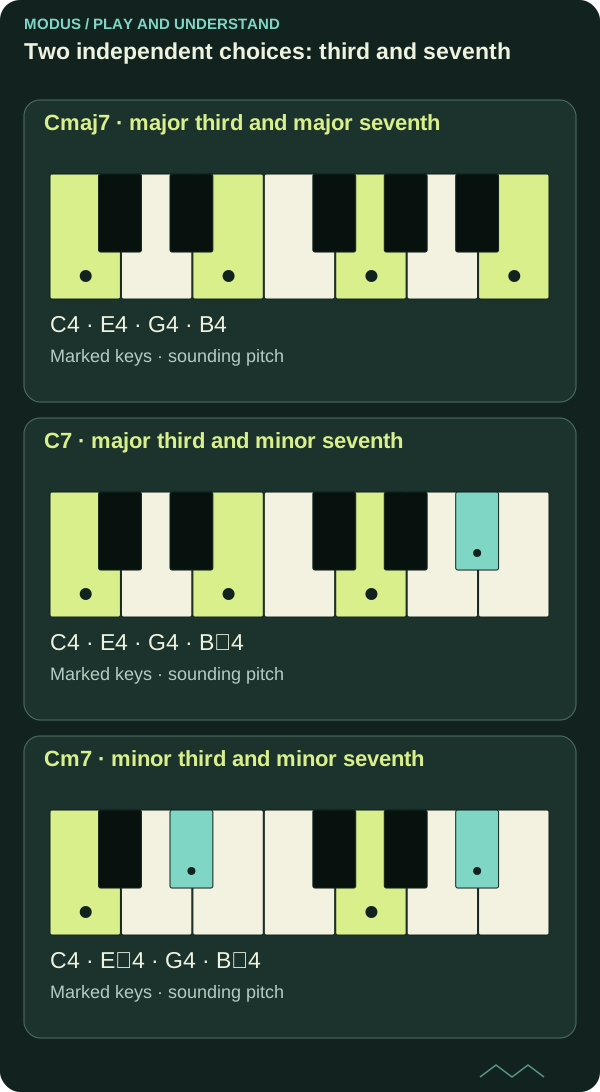
Read the diagram as text
- Cmaj7 · major third and major seventh: C4 → E4 → G4 → B4
- C7 · major third and minor seventh: C4 → E4 → G4 → B♭4
- Cm7 · minor third and minor seventh: C4 → E♭4 → G4 → B♭4
Two questions clarify the symbol
First ask: Is the third major or minor? Then ask: Is the seventh major or minor? Cmaj7 and C7 both have a major third but different sevenths. Cm7 and Cm(maj7) both have a minor third but different sevenths.
In Cm(maj7), “maj7” means the seventh is major. It does not mean the triad is major. The brackets make this combination easier to read.
Let one voice reveal the difference
Keep C, E and G and alternate between B and B♭. You move between Cmaj7 and C7 with only one note. Then keep C, E♭ and G and do the same: now you are comparing Cm(maj7) and Cm7.
The term dominant seventh describes a chord type with a major third and a minor seventh. Whether it actually functions as a dominant depends on the context. In blues and modal music it can have other roles too.
See the triad inside the seventh chord
Em7 consists of E–G–B–D. The first three notes form E minor; D is the minor seventh. Emaj7 consists of E–G♯–B–D♯. Here both the third and seventh are major. Keep the questions about the third and seventh separate when explaining the chord.
First locate the triad on the instrument. Then add the seventh and listen to the difference. You do not need an entirely new pattern to understand the extra note.
FROM READING TO PLAYING
Try it yourself.
Choose Cmaj7 and C7 in the chord workshop. See which key moves. Repeat with Cm7 and Cm(maj7), then try a piano inversion that keeps the remaining notes close together.
Compare seventh chords in the workshopCHECK YOUR UNDERSTANDING
What do you remember?
Three questions about what you have read. Get all three right to complete the quiz. Try as many times as you like.
Completion is saved in this browser and shared between Norwegian and English.
You answered all three questions correctly. Take the idea to your instrument.
Back to the article library ↗︎