
One scale pattern, new target notes
You can keep one familiar scale pattern through a progression while still following the harmony. The key is to see which notes in the pattern belong to the current chord.

A shared note collection
Use Em–C–G–D as an example. All four triads can be built from E, F♯, G, A, B, C and D. This is the note collection of E natural minor and G major.
Find the notes in a fretboard area you already know, or on piano. Keep that area throughout the progression. You do not need to switch to a new physical scale pattern for each chord.
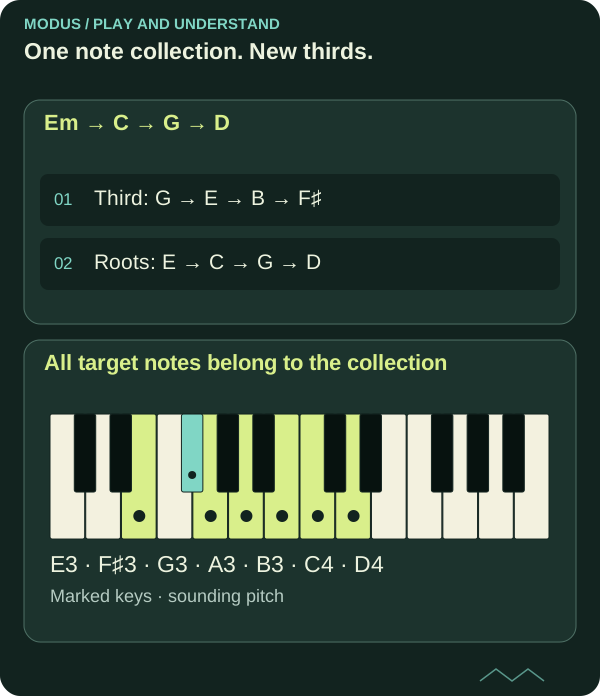
Read the diagram as text
- Em → C → G → D: Third: G → E → B → F♯; Roots: E → C → G → D
- All target notes belong to the collection: E3 → F♯3 → G3 → A3 → B3 → C4 → D4
The chord highlights different notes
The chord tones are E–G–B in Em, C–E–G in C, G–B–D in G and D–F♯–A in D. They all lie within the same pattern. What changes is which notes serve as the root, third and fifth of the current chord.
G is the minor third of Em, the perfect fifth of C and the root of G. Over D, G is a fourth above the root and is not part of the D major triad. The same note can therefore have a different effect when the chord changes.
Choose one target note per chord
Start with the roots E–C–G–D. Play one note at each chord change. Then try the thirds G–E–B–F♯. Both lines follow the harmony without requiring a new scale for each change.
Once the target notes feel secure, add one or two scale notes on the way to them. Notes outside the chord can act as passing notes, colour or tension. Their duration, rhythm and subsequent movement affect how they sound.
One pattern is a starting point, not a rule
The method works here because the chords share a diatonic note collection. If the progression introduces a note outside the scale, listen to and examine the new relationship. One fixed pattern will not necessarily fit every part of every piece.
The point is to connect a familiar pattern to the harmony. Later you can extend the range or explore other colours. Let that be a musical choice, rather than an automatic requirement to use four different patterns over four chords.
FROM READING TO PLAYING
Try it yourself.
Play Em–C–G–D slowly. First use only E–C–G–D as targets, then G–E–B–F♯. Finally make a short phrase that lands on a chosen chord tone at each change.
Practise with E natural minorCHECK YOUR UNDERSTANDING
What do you remember?
Three questions about what you have read. Get all three right to complete the quiz. Try as many times as you like.
Completion is saved in this browser and shared between Norwegian and English.
You answered all three questions correctly. Take the idea to your instrument.
Back to the article library ↗︎