
The circle of fifths: a map of related keys
The circle of fifths brings keys, key signatures and relative minors together in one map. Use it to understand chord connections, transpose your music and find a starting point.

What does the circle of fifths show?
Put C at the top. Go up a perfect fifth to G. Another fifth gives D, followed by A, E and B. Continue around the full circle and you return to the pitch class C.
A perfect fifth is seven semitones, for example C–G. In the other direction you follow descending fifths, or ascending fourths: C–F–B♭–E♭. The octave you play in may change; we are mapping relationships between pitch classes.
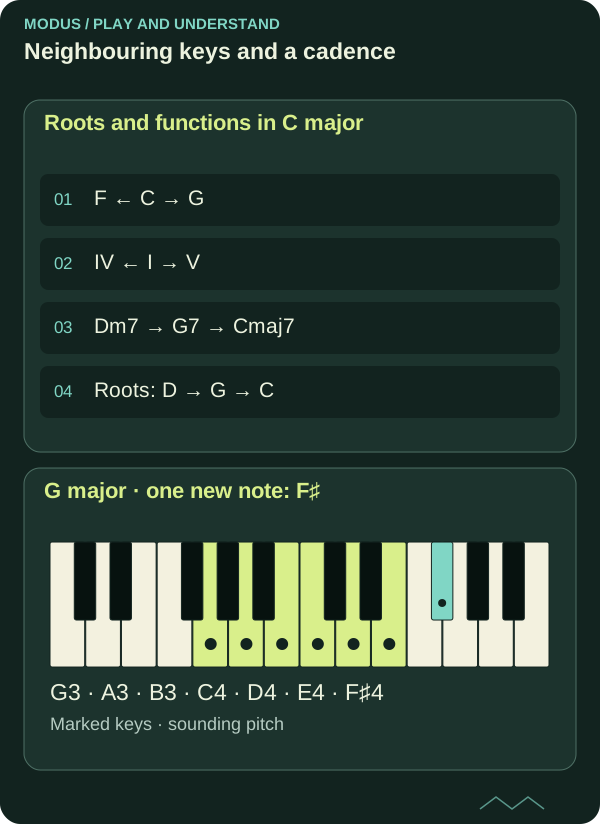
Read the diagram as text
- Roots and functions in C major: F ← C → G; IV ← I → V; Dm7 → G7 → Cmaj7; Roots: D → G → C
- G major · one new note: F♯: G3 → A3 → B3 → C4 → D4 → E4 → F♯4
Key signatures: one new accidental per step
Starting from C major, which has no sharps or flats in its key signature, each clockwise step adds one sharp. G major has F♯. D major has F♯ and C♯. Going anticlockwise adds one flat: F major has B♭, and B♭ major has B♭ and E♭.
Neighbouring keys on the circle share six of seven scale notes. C major and G major, for example, differ only in F and F♯. They sit close on the map even though their tonics are a fifth apart.
At the bottom you meet F♯ major and G♭ major. On a standard equal-tempered piano they use the same keys, but the notes are spelled differently: F♯ major has six sharps, G♭ major six flats. The circle shows common spellings; keys such as C♯ major with seven sharps also exist.
Major and relative minor share a key signature
The inner ring shows relative minor keys. C major and A minor have no sharps or flats. G major and E minor have one sharp. D major and B minor have two.
The relative minor is a minor third below the major tonic, or on the sixth degree of the major scale. C major and A natural minor therefore share the same notes but have different tonics and different roles for their notes.
| Major | Relative minor | Key signature |
|---|---|---|
| C major | A minor | None |
| G major | E minor | F♯ |
| D major | B minor | F♯, C♯ |
| F major | D minor | B♭ |
| B♭ major | G minor | B♭, E♭ |
In tonal minor, a raised seventh is often used as a leading note. E minor may therefore use D♯ in a B7 chord, even though its key signature only contains F♯. The circle shows key signatures, not every possible note in a piece.
Find I, IV and V next to each other
Choose a major key on the outer ring. Its anticlockwise neighbour shows the root of IV, the subdominant. Its clockwise neighbour shows the root of V, the dominant. Tonic I sits between them on this arc of the circle.
You can build C–F–G–C, or I–IV–V–I. Move the same idea to D major: D–G–A–D. The chord names change but the scale-degree relationships stay the same.
This example uses major keys. In minor, you cannot simply read all chord types from the outer ring. In A minor, for example, Dm is common on iv, while E or E7 can act as dominant V or V7.
Hear the fifths movement in ii–V–I
In C major you can play Dm7–G7–Cmaj7. The chord roots follow D–G–C: two anticlockwise steps on the circle. These are descending fifths, or ascending fourths in a different register.
Notice that D appears as a major key on the outer ring, while the chord here is Dm7. The circle shows relationships between roots. Chord quality depends on the key and musical context.
Also listen to B and F in G7. They can move to C and E in the tonic chord. The circle shows root movement; voice leading explains how the notes inside the chords connect the change.
Where do modes fit in?
The circle of fifths is primarily a map of keys and key signatures. It does not tell you on its own which mode is the musical centre.
C Ionian, D Dorian and E Phrygian all use C, D, E, F, G, A and B. They share the same notes but have different roots and interval relationships. D major on the outer circle is different from D Dorian.
Use the circle to find relationships, and use harmony and your ear to decide where the music feels at home. You can keep one scale map through a progression while following which chord tones become important at each change.
A short practice routine
First choose C major and play C–F–G–C. Say I–IV–V–I as you play. Then move the same pattern to G major: G–C–D–G. Next try D major: D–G–A–D.
Finally, play Dm7–G7–Cmaj7 at a relaxed tempo. Sing the roots D–G–C and notice the direction. You need not memorise the entire circle at once; learn a few connections by hearing and using them.
Use the circle without replacing your scale pattern
G major and E natural minor share G, A, B, C, D, E and F♯. You can therefore use the same note collection over many diatonic chords from this family. The circle helps you find the key signature; it does not say that every chord should be major.
Play Em–C–G–D and locate the chord tones within an area you already know. Notice that C major uses C–E–G, while D major uses D–F♯–A. You can keep the pattern even as the target notes change.
FROM READING TO PLAYING
Try it yourself.
Open Dm7–G7–Cmaj7 in the chord workshop. Play and sing D–G–C and find the anticlockwise movement on the circle. Then move the cadence to G major: Am7–D7–Gmaj7. Keep ii–V–I and listen for where the music lands.
Play Dm7–G7–Cmaj7 in the chord workshopCHECK YOUR UNDERSTANDING
What do you remember?
Three questions about what you have read. Get all three right to complete the quiz. Try as many times as you like.
Completion is saved in this browser and shared between Norwegian and English.
You answered all three questions correctly. Take the idea to your instrument.
Back to the article library ↗︎